A photograph of a beautiful coffee station implies that a drawer full of needles, discs, funnels and springs is normal, and that every object in it is somehow essential. It is not. The gap between a routine that flows and a shelf of objects you stop touching after two weeks is almost entirely a question of verdicts: knowing which tools change what is in the cup, and which ones only change how the counter looks.
That distinction is missing from most coffee content. Accessory round-ups are written to sell, so every tool is described as a must-have, and the result is a specific, well-documented anxiety: newcomers buy eight accessories at once and then cannot tell which one is helping. Meanwhile the community answers to the same questions have been stable for years. A scale is worth it. A puck screen is mostly about cleanliness. A matched tamper beats an expensive one.
This guide takes the opposite route. Every gadget below is sorted into one of four verdicts — Actually Useful, Useful in the Right Setup, Convenience Only, or Skip at First — and each verdict is backed by the tool's core specifications and a direct link into our Home Coffee Bar Setup collection, where the full regional model picks and current listings live. Nothing here is recommended because it looks good in a photograph.
⚡Quick Comparison MatrixClick to ExpandAt a Glance: Gadget Verdicts & Regional Price Snapshot
Expand TableCollapse Table
At a Glance: Gadget Verdicts & Regional Price Snapshot
| Product | Verdict | Regional Models & Pricing Snapshot | Core Specs & Highlights | Friction Point Solved |
|---|---|---|---|---|
| Maestri House S2 Espresso Coffee Scale | Actually Useful | US: Maestri House S2 (approx. $25.59) · UK: Maestri House S2 (approx. £25.30) · DE: Maestri House S2 (approx. €25.49) · FR: Ultrean 3kg (approx. €17.09) · IT: BAGAIL 3kg (approx. €24.68) · ES: BAGAIL 3kg (approx. €21.42) | 4.13 × 4.13 × 0.78 in, 0.75 lb; 0.1g precision across 0.5–2000g; automatic and manual timer; three switchable units; 500 mAh USB-C rechargeable; borosilicate glass platform | Dosing by eye, where a "double shot" can drift anywhere between 14g and 24g of coffee |
| Normcore 54mm Magnetic Dosing Funnel | Actually Useful | US: Normcore V2 54mm (approx. $19.19) · UK: Sage 54mm (approx. £14.95) · DE: Ailelan 51mm (approx. €7.64) · FR: Quvxzy 54mm (approx. €8.99) · IT: IBILI (approx. €6.08) · ES: Lacor Inox (approx. €54.74) | 18mm anodised aluminium collar; eight neodymium magnets; twist-to-lock fit; dishwasher-safe body | Static-charged grounds spilling over the basket rim on every single grind |
| Normcore V4 Spring-Loaded Espresso Tamper | Actually Useful | US: Normcore V4 53.3mm (approx. $33.60) · UK: Moqinai 51mm (approx. £9.49) · DE: Vicloon 51mm (approx. €9.34) · FR: hicoosee 51mm (approx. €13.98) · IT: 51mm Barista (approx. €9.99) · ES: Vicloon 51mm (approx. €9.99) | Interchangeable calibrated 15/25/30 lb springs; flat stainless base; anodised aluminium handle; matching stand | Tilted or over-compressed pucks that send water drilling down one side of the bed |
| Veken Airtight Coffee Canister | Actually Useful | US: Veken 22oz (approx. $23.73) · UK: Harbour Housewares 3pc (approx. £7.99) · DE: KC Kitchen 1kg (approx. €28.85) · FR: KC Kitchen 1kg (approx. €34.95) · IT: Bialetti Moka 250g (approx. €11.36) · ES: ACOMTUO 1.8L (approx. €13.99) | One-way CO2 release valve; clear acrylic viewing window; date-tracker dial; 22oz body with stainless scoop | Oxygen staling the beans in a clipped bag, and roast dates nobody can remember |
| Nessus WDT Espresso Distribution Tool | Useful in the Right Setup | US: Nessus 10-Needle (approx. $11.99) · UK: MEION 7-Needle (approx. £12.58) · DE: MEION 7-Needle (approx. €12.58) · FR: HOTUT 7-Needle (approx. €11.99) · IT: Subminimal (approx. €22.76) · ES: 6-Needle (approx. €5.19) | Ten 0.35mm food-grade stainless needles; configurable five-to-nine needle head; built-in cleaning brush in the stand; aluminium handle | Clumped beds and channeling, but only in non-pressurised basket setups |
| Adorever Stainless Steel Milk Frothing Pitcher | Useful in the Right Setup | US: Adorever 12oz (approx. $8.49) · UK: PLACHIDAY 350ml (approx. £6.13) · DE: BASECENT 350ml (approx. €6.98) · FR: NewGF 350ml (approx. €10.99) · IT: Omtofo 350ml (approx. €9.99) · ES: UMUACCAN 350ml (approx. €11.99) | Food-grade 304 stainless steel; internal oz/ml measurement lines; pointed eagle-beak spout; dishwasher safe | Oversized pitchers that waste milk and bury the steam tip too deep to texture |
| Cosori Gooseneck Electric Kettle | Useful in the Right Setup | US: Cosori 0.8L (approx. $59.49) · UK: RHD 0.9L (approx. £64.99) · DE: RHD 0.9L (approx. €69.99) · FR: huslog 1L (approx. €69.99) · IT: huslog 1L (approx. €33.24) · ES: huslog 1L (approx. €35.99) | Precision gooseneck spout; 40–100°C digital temperature control; 304 stainless steel body; 0.8L working capacity | Boiling water poured from an unregulated kettle, scalding light roasts and flooding the bed |
| Bodum Pour Over Coffee Maker | Useful in the Right Setup | US: Bodum 34oz (approx. $19.99) · UK: Hario VDD-02B 700ml (approx. £20.16) · DE: Bodum 1L (approx. €20.99) · FR: SEB Carafe (approx. €11.49) · IT: Coffee Gator 400ml (approx. €16.78) · ES: Amazon Basics 0.97L (approx. €14.46) | High-heat borosilicate glass carafe; reusable stainless steel filter; cork grip; 34oz working volume | Paper filters that run out, and immersion brews that turn out heavy with sediment |
| AIEVE / XZMCAT Espresso Cooling Balls | Useful in the Right Setup | US: AIEVE 2-Pack (approx. $13.98) · UK: SAICOOS 55mm (approx. £11.99) · DE: AIEVE Inox (approx. €13.99) · FR/IT/ES: XZMCAT Inox 304 (approx. €14.99–€16.99) | Food-grade 304 stainless steel frosted spheres on a wire cradle; sealed interior; 20–30°C instant drop at the spout | Ice cubes that dilute iced coffee before the drink has even chilled |
| De'Longhi DLSC084 Espresso Knock Box | Convenience Only | DE/FR/IT: De'Longhi DLSC084 (approx. €22.40–€22.99) · US: Breville Knock Box 10 (approx. $33.95) · UK: JinZeYou Bin (approx. £12.99) · ES: Ideal Swan (approx. €17.98) | Brushed stainless or ABS shell; removable rubberised strike bar; weighted non-slip base; roughly 10-puck capacity | Carrying a dripping portafilter across the kitchen to a plastic bin |
| Ninja Luxe Café Premier 3-in-1 Espresso Machine | Consolidation, Not a Fix | US: ES601 (approx. $499.99) · UK: ES601UKBK (approx. £499.00) · DE: ES601 Grey Metal (approx. €499.90) · FR/IT/ES: ES601EU (approx. €429.00–€449.99) | 25-setting conical burr grinder; Barista Assist dosing and assisted tamping; four-mode hot/cold frother; 15-bar espresso, cold brew and drip in one chassis | A beginner workflow that stalls on grind and tamp guesswork |
| Ninja Dual-Brew / Prestige 2-in-1 Coffee Maker | Consolidation, Not a Fix | US: Pod & Grounds PB051ST (approx. $99.98) · UK: Prestige CFN802UK (approx. £259.99) · DE/FR/IT: Prestige 2-in-1 (approx. €185.00–€237.74) · ES: Prestige 2 en 1 (approx. €272.99) | Pod and grounds dual brewing; 1.8L carafe; ten programmable drink sizes; fold-away milk frother | Two separate machines competing for one counter, one of which is idle half the week |
| Savepod PodMaker Reusable Pod System | Consolidation, Not a Fix | US: PodMaker Bundle (approx. $64.99) · UK: Savepod Lite (approx. £35.27) · DE: Savepod Set (approx. €78.33) · FR/IT/ES: Savepod 200 Filters (approx. €35.00–€35.68) | 100% compostable burst-resistant paper filters; snap-lock universal ring; stainless steel scoop | Disposable plastic pod waste and the stale pre-ground coffee inside it |
Prices and availability above are collected from the regional marketplaces and tracked in the guide linked below; they change frequently and are shown here as a snapshot for comparison.
How to Tell a Useful Gadget From a Gimmick
Before any verdict, there is a test. It takes four questions, and it settles almost every accessory argument in under a minute. The full specifications and regional model picks for each tool sit in the collection's comparison matrix; what this article supplies is the judgement layer on top.
1. Which step of the routine does it touch? Every espresso routine runs a fixed sequence — grind, dose, distribute, tamp, brew, steam, clean. If a tool does not sit on one of those steps, it is decoration. The full espresso workflow breakdown maps each step to the tools that genuinely belong to it.
2. Does it change the cup, or only the counter? This is the dividing line that most reviews blur. A scale changes the cup, because it turns dosing into a repeatable number. A knock box does not; it changes your kitchen. Both can be worth buying — but they are not the same kind of purchase, and only one of them fixes a bad shot.
3. How often will you actually use it? Daily friction justifies counter space. A tool you reach for twice a month is a drawer item, and drawer items should not be chosen by their looks.
4. Does it physically fit your machine? This is where money is most often wasted. Portafilters come in 51mm, 54mm and 58mm, and a funnel or tamper sized for one will not seat in another. Steam wand reach, drip-tray clearance and cabinet headroom all decide the same question: does it work here, on this machine?
Once those four questions are answered, every gadget lands in one of four verdicts:
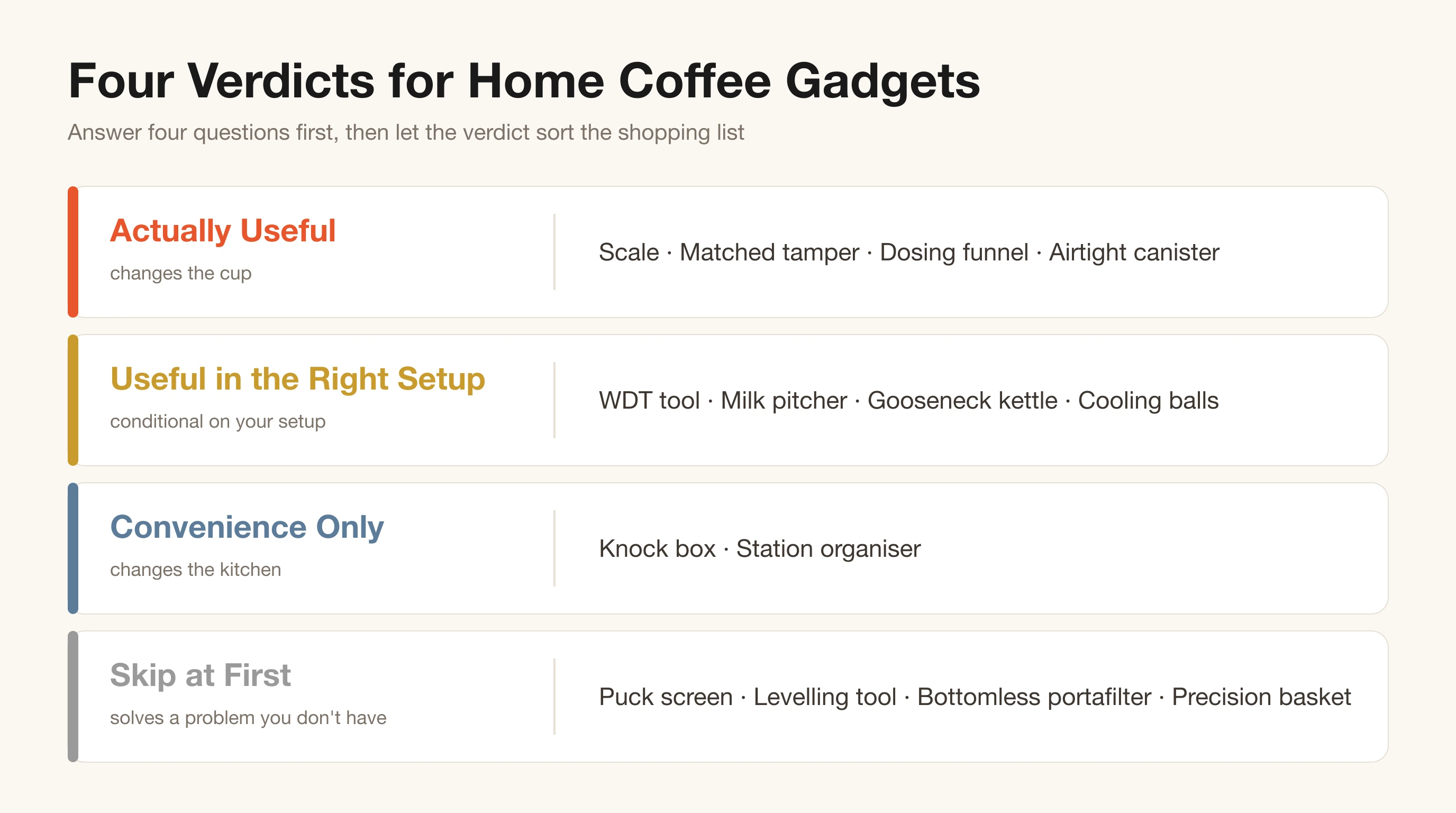
- Actually Useful — it changes what is in the cup, or removes friction you meet every single morning.
- Useful in the Right Setup — genuinely effective, but only when your basket, your drinks or your brew method aligns with it.
- Convenience Only — it makes the kitchen calmer and the workflow cleaner, without touching extraction.
- Skip at First — it solves a problem a beginner does not yet have, and it is best bought after the basics are stable.
Actually Useful: The Gadgets That Change the Cup
These four earn their space in almost every setup, and they do it by changing measurements, structure or freshness rather than appearance.
Coffee Scale — the cheapest upgrade that changes everything
Espresso is a ratio, not a feeling. Without a scale, a "double shot" can land anywhere between 14 and 24 grams of coffee, and between 25 and 60 grams of liquid, which is the difference between sour, thin and harshly bitter. A 0.1-gram scale turns that into a number you can adjust one variable at a time.
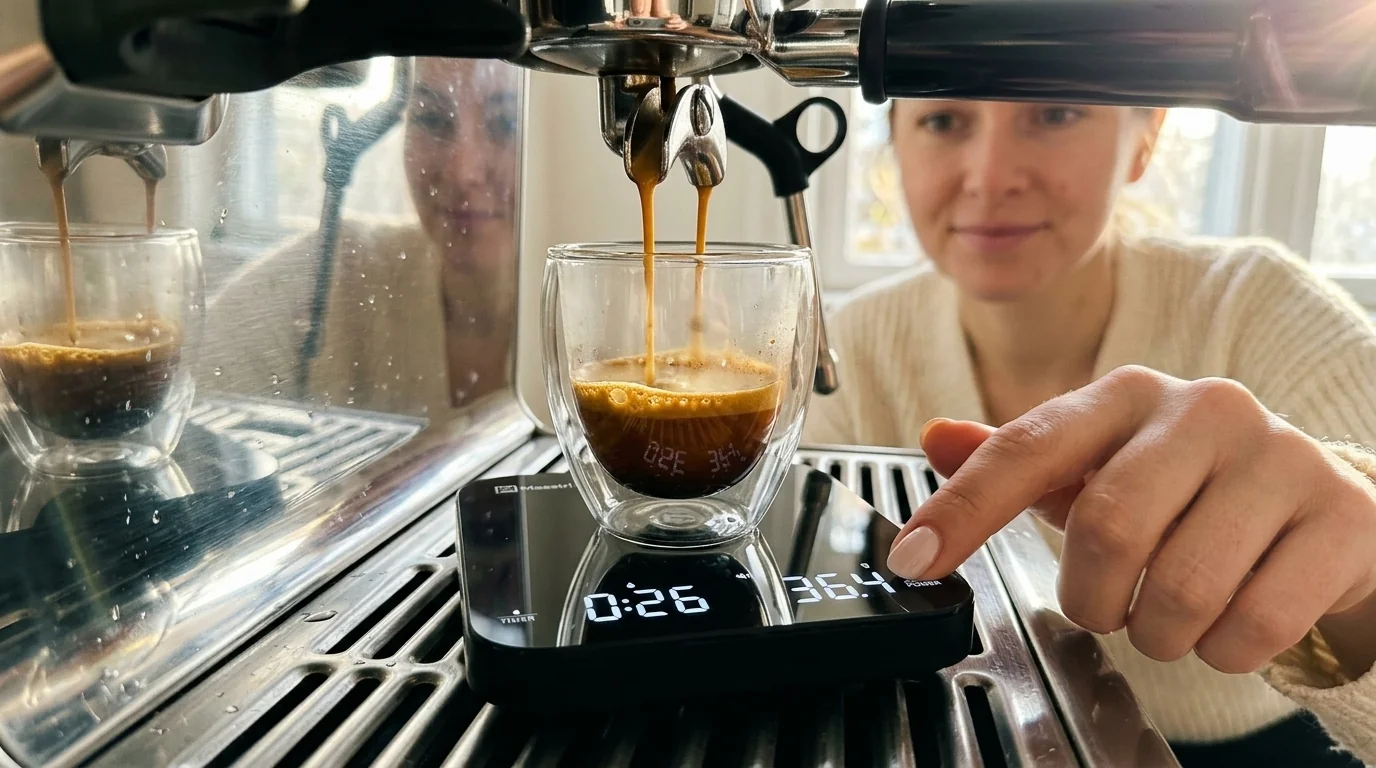
The pick in the collection is the Maestri House S2 espresso coffee scale. Its core data: a 4.13 × 4.13 × 0.78-inch body weighing 0.75 lb, reading from 0.5g to 2000g in 0.1g increments, with automatic and manual timer modes, three switchable units (g/oz/ml), and a 500 mAh USB-C battery rated at roughly 90 days per charge with automatic sleep. Regional picks sit at approx. $25.59 in the US, approx. £25.30 in the UK and approx. €25.49 in Germany, with a wider 3kg-platform Ultrean at approx. €17.09 in France and BAGAIL units at approx. €24.68 in Italy and approx. €21.42 in Spain.
Why the verdict is "actually useful": it is the only accessory on this list that makes every other variable diagnosable. When a shot tastes wrong, the scale tells you whether the problem is grind, dose or yield — and that is the entire foundation of dialling in.
Before you add it: measure the clearance between the portafilter spouts and the drip tray. Your tallest cup plus the height of the scale has to fit under the group head.
Dosing Funnel — mess intercepted at the source
Grinding straight into an open basket produces a fluffy, static-charged mound that spills over the rim, and every spill is a dose that no longer matches the recipe. A funnel extends the basket wall so the full dose lands inside and can be stirred and levelled before tamping.
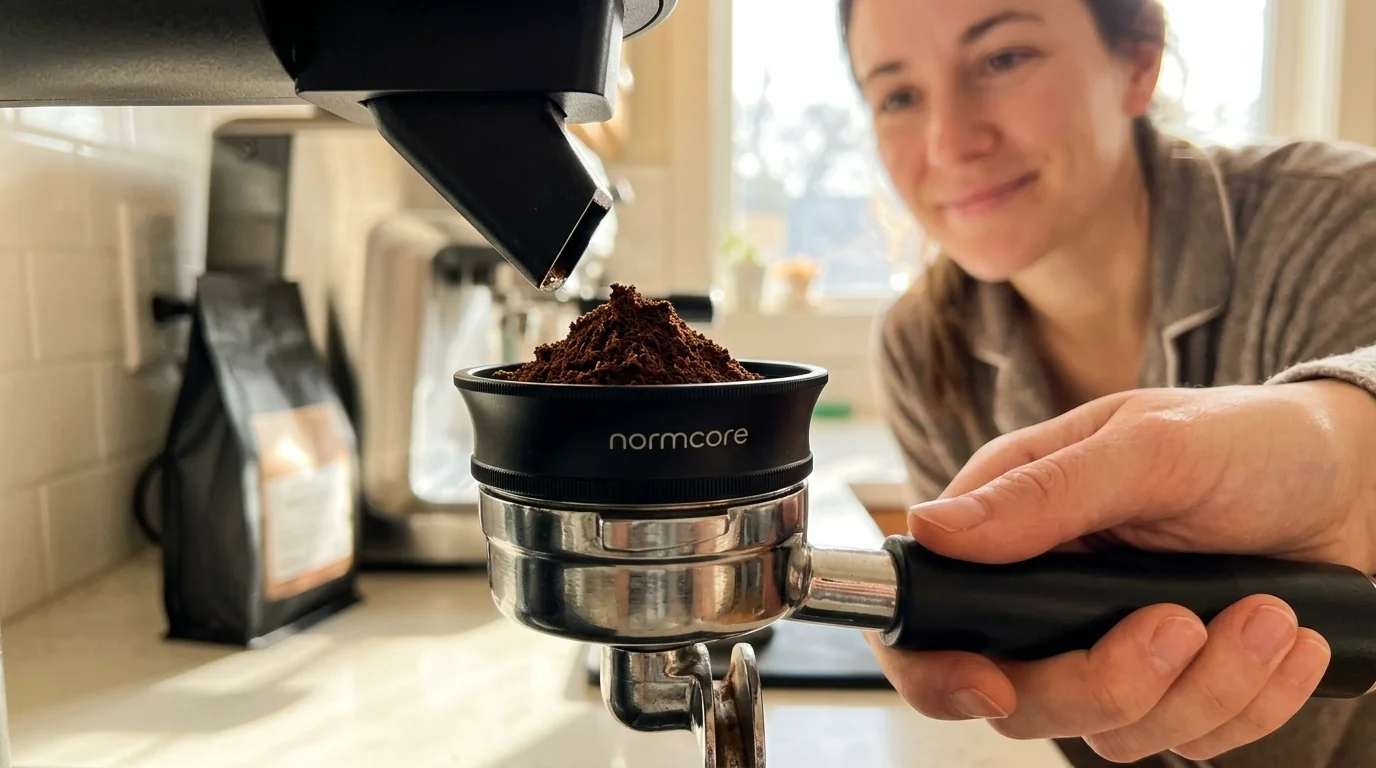
The collection's pick is the Normcore 54mm magnetic dosing funnel: an 18mm anodised aluminium collar held by eight neodymium magnets, a twist-to-lock fit for 54mm Breville-style portafilters, and a dishwasher-safe finish. Regional snapshots run from approx. $19.19 for the US V2, approx. £14.95 for the Sage OEM funnel in the UK, and approx. €7.64 for a 51mm Ailelan magnetic ring in Germany, up to approx. €54.74 for a large Spanish Lacor stainless funnel.
Why the verdict is "actually useful": it does not make better espresso on its own, but it removes a mess you meet at every single grind, and it protects the dose the scale just measured. That combination is why it sits above most "nice to have" tools.
Before you add it: confirm your basket diameter first. A funnel sized for 51mm will not fit a 54mm Breville basket, and a 58mm commercial collar will not fit an entry-level machine.
Espresso Tamper — fit matters far more than price
Tamping looks like the simplest step and is quietly one of the most destructive. Press at an angle and water finds the shallow side first, drilling a channel while the rest of the bed stays under-extracted. The result is the familiar split personality of a shot that tastes sour and bitter at the same time.
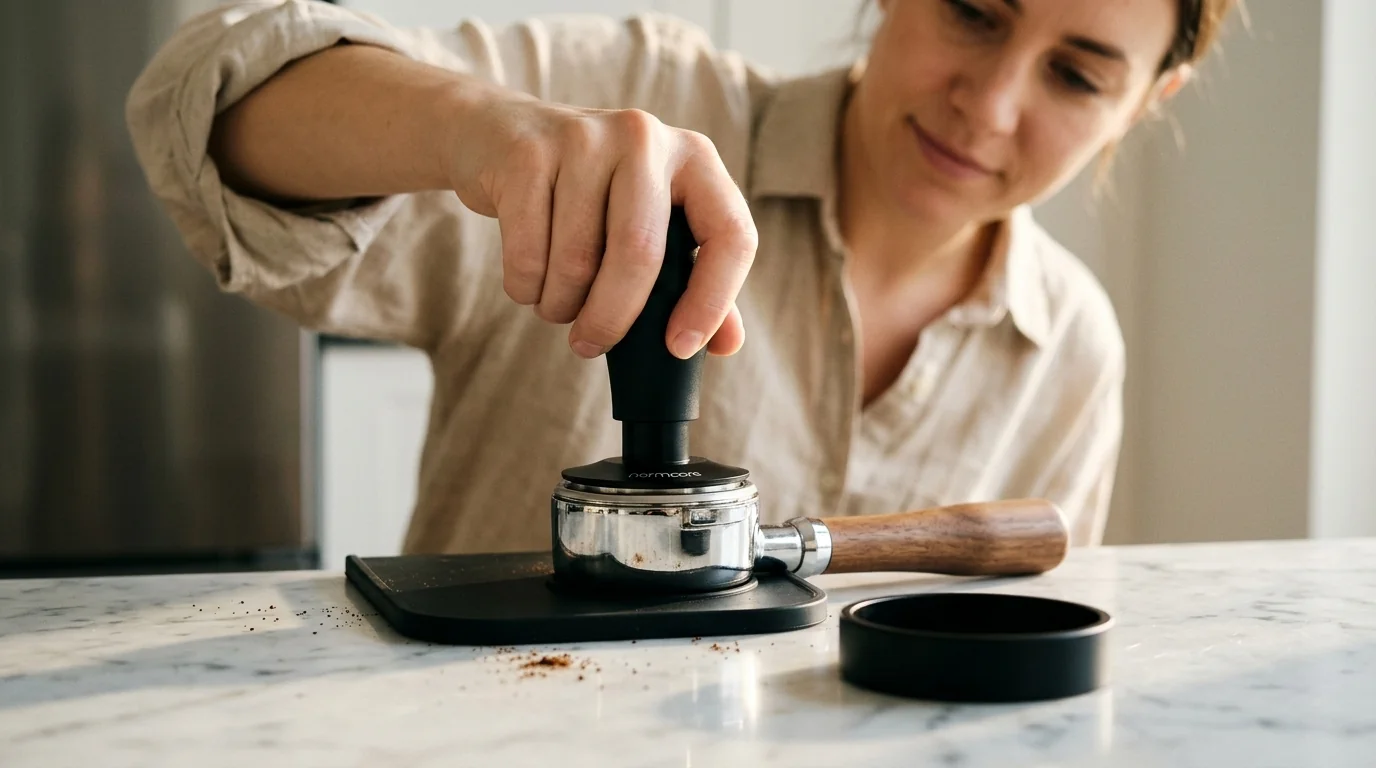
The collection's pick is the Normcore V4 spring-loaded tamper, with interchangeable calibrated 15 lb, 25 lb and 30 lb springs that click at a known force, a flat base for level compression, an anodised aluminium handle and a matching stand. It is listed at approx. $33.60 for the 53.3mm version in the US, while solid 51mm tampers cover most of Europe at approx. €9.34 in Germany, approx. €13.98 in France and approx. €9.99 in Italy and Spain.
Why the verdict is "actually useful": the objective is a level, evenly compressed bed, and a spring-loaded click makes that repeatable regardless of how tired the wrist is. But the caveat matters as much as the recommendation — if the tamper included with your machine already seats correctly and levels the puck, there is no functional reason to replace it.
Before you add it: measure the basket's internal diameter. A 51mm tamper in a 54mm basket leaves a ring of untamped coffee that ruins the seal, and a 54mm tamper will not enter a 51mm basket at all.
Airtight Canister With a One-Way Valve — freshness you can see
Roasted coffee starts going stale the moment it leaves the roaster. Oxygen oxidises the aromatic oils, and a clipped bag slows that process without stopping it. A canister with a one-way valve does two things a bag cannot: it seals oxygen out on a stable gasket, and it vents the carbon dioxide freshly roasted beans release so the lid is not pushed open from the inside.
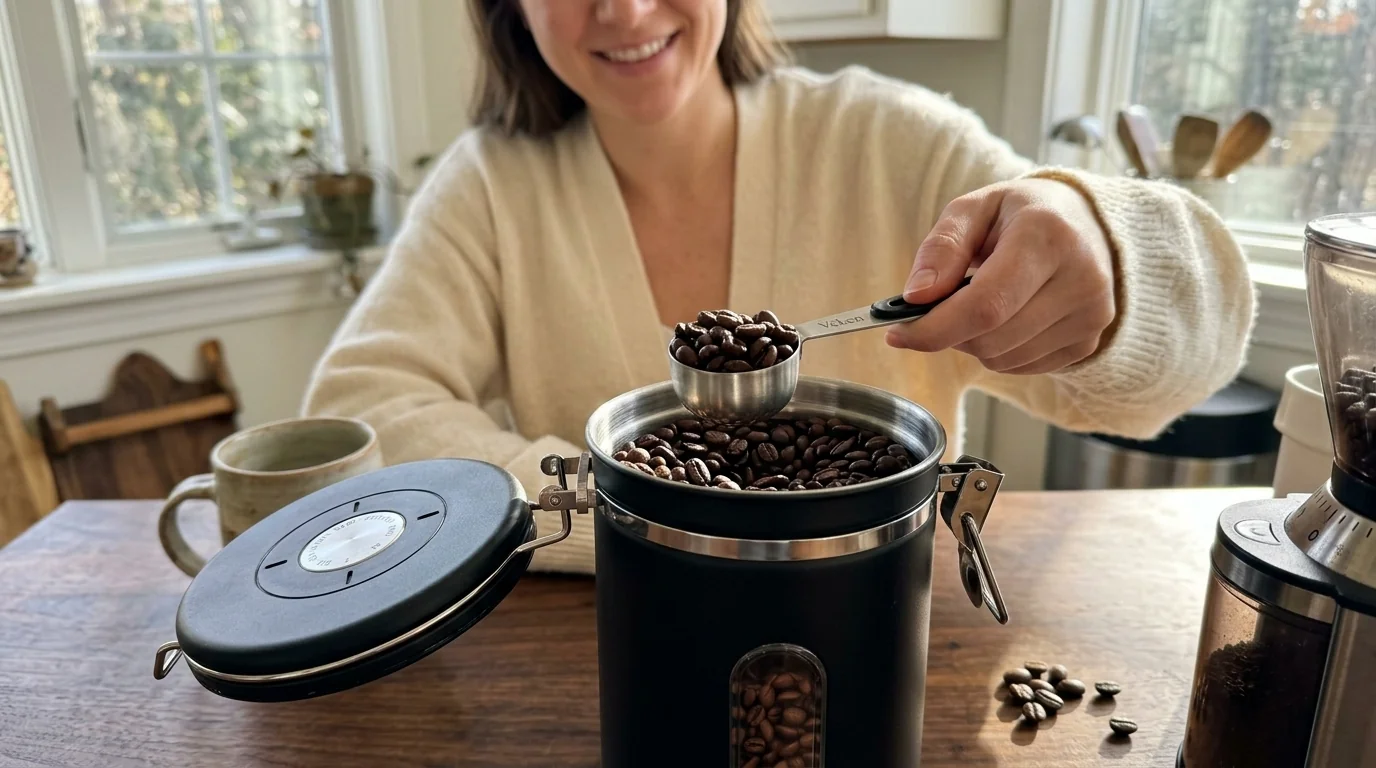
The pick in the collection is the Veken airtight coffee canister: a 22oz body with a one-way CO2 release valve, a clear acrylic window, a date-tracker dial on the lid and a stainless scoop. Snapshots run at approx. $23.73 for the US 22oz, approx. £7.99 for a UK three-piece set, approx. €28.85 for a 1kg German KC Kitchen jar, and approx. €11.36 for a compact 250g Italian Bialetti canister.
Why the verdict is "actually useful": freshness is a variable you control for almost nothing, and the window plus date dial remove the two habits that defeat storage, which are opening the lid to check the level and forgetting when the bag was opened.
Before you add it: buy the size that matches your consumption. A large canister that sits half empty holds a great deal of air, which defeats the seal.
Useful in the Right Setup: The Conditional Tier
These tools are not gimmicks. They are simply conditional, and the condition is real — if it is not met, they sit unused.
WDT Tool — only when distribution is your bottleneck
Freshly ground coffee clumps. Static and oils bind fines into dense pockets that survive tamping, and water then takes the path of least resistance straight through one weak point. A WDT tool stirs fine needles through the bed to break those clumps apart before tamping.
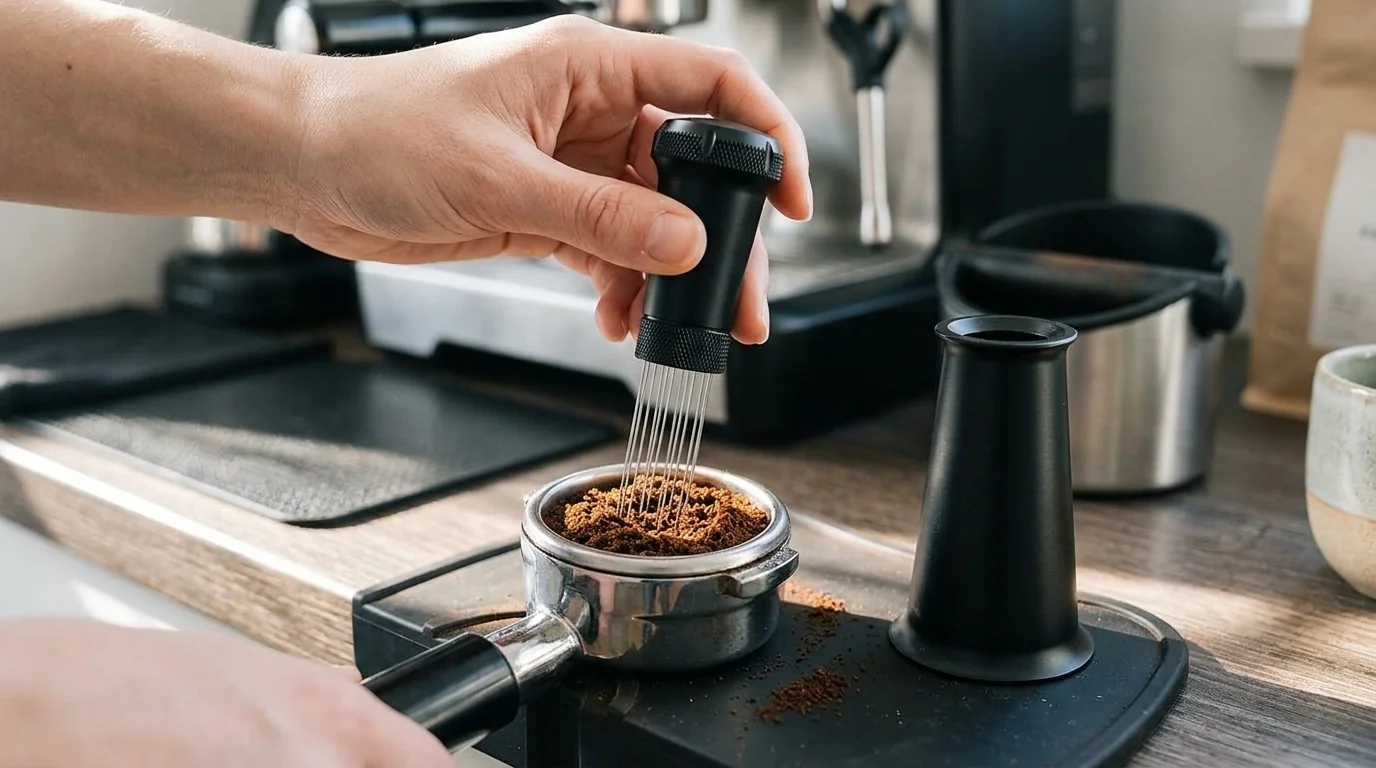
The collection's pick is the Nessus WDT distribution tool: ten food-grade stainless 0.35mm needles, a configurable head that can run five to nine needles, a built-in cleaning brush in the stand and an aluminium handle, listed at approx. $11.99 in the US, approx. €12.58 for the MEION seven-needle version in Germany and approx. €22.76 for a retractable-needle Subminimal tool in Italy.
The condition: WDT does its best work with a non-pressurised basket and freshly ground coffee. With a pressurised dual-wall basket or pre-ground coffee, it changes nothing. And if you are still learning dose, grind setting and a level tamp, adding needle distribution introduces one more variable before the fundamentals are in place.
Milk Pitcher — only if you actually steam
Whether a pitcher belongs on the counter depends entirely on what is in your cup. If the routine is espresso or americano, it is not needed at all. If it is lattes and flat whites, the pitcher becomes part of the core workflow.
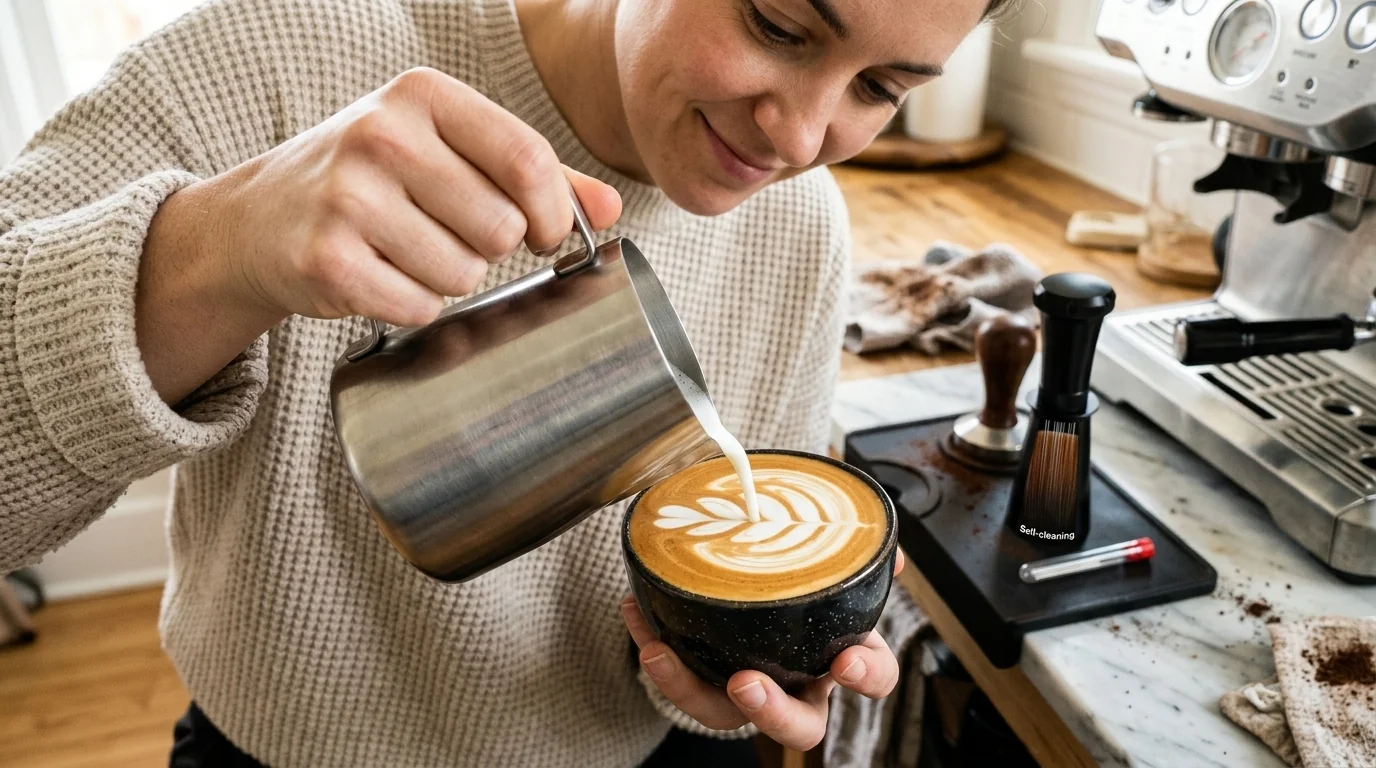
The Adorever stainless steel milk frothing pitcher is the collection's pick: food-grade 304 stainless steel, a pointed eagle-beak spout, internal oz/ml markings and an ergonomic handle, all dishwasher safe. The 12oz version is listed at approx. $8.49 in the US, with 350ml PLACHIDAY and BASECENT pitchers at approx. £6.13 in the UK and approx. €6.98 in Germany.
The condition: capacity has to match the drink. Domestic steam wands are weaker than commercial ones, so a large 600ml jug forces you to pour far more milk than a single serving needs just to submerge the tip, and the remainder is wasted. Around 350ml keeps the steam tip at the right depth for one drink and saves counter space.
Gooseneck Kettle and Permanent-Filter Pour-Over — filter coffee only
Pour-over is unforgiving about two things: temperature and flow. Water straight off the boil scalds delicate light roasts, and a wide spout dumps the bloom in one go and floods the bed. Neither is fixable by technique alone.
The Cosori gooseneck electric kettle answers the temperature problem with 40–100°C digital control, a narrow curved spout that delivers a steerable pencil-thin stream, and a 304 stainless steel 0.8L body — approx. $59.49 in the US, approx. £64.99 in the UK, approx. €69.99 in Germany, and roughly half that for the 1L huslog in Italy at approx. €33.24. The companion is the Bodum pour over coffee maker, a borosilicate carafe with a reusable stainless filter and cork grip at approx. $19.99 in the US, approx. £20.16 for the Hario VDD-02B in the UK and approx. €20.99 in Germany.
The condition: this pair is for filter coffee. If the routine is espresso, or full carafes of drip, neither earns its footprint — a gooseneck pours slowly by design, and the whole point is the manual control.
Espresso Cooling Balls — a genuine niche, not a universal need
When espresso leaves the portafilter at over 90°C, delicate fruity and floral aromatic compounds evaporate into the room and leave the heavier bitter notes behind. Routing the stream across a frozen metal surface as it leaves the spout drops the temperature by 20–30°C within seconds, trapping those aromatics in the liquid and softening harsh roast bitterness.
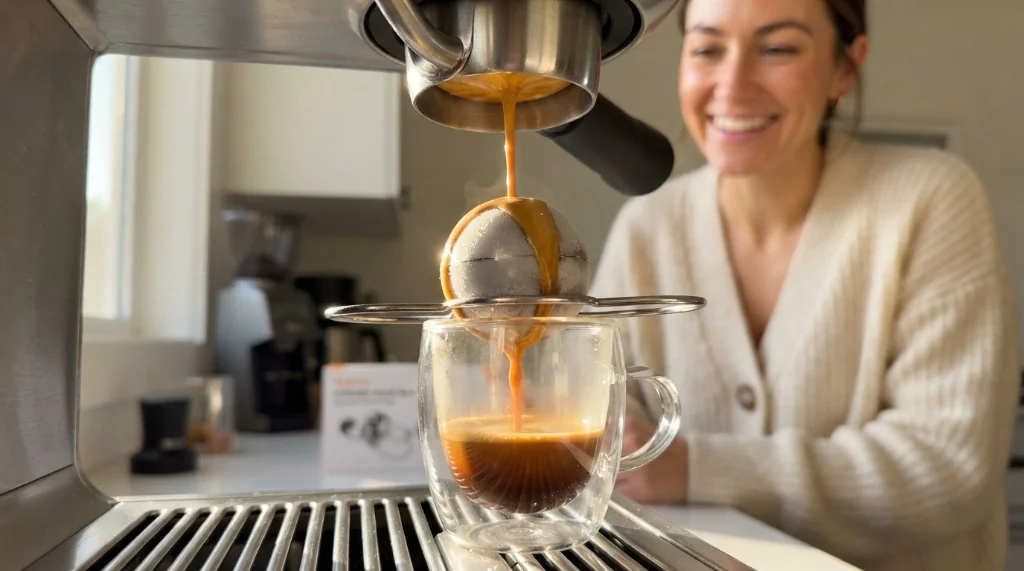
The AIEVE / XZMCAT espresso cooling balls use food-grade 304 stainless spheres on an included wire cradle, listed at approx. $13.98 in the US, approx. £11.99 for a 55mm SAICOOS set in the UK, approx. €13.99 in Germany and approx. €14.99–€16.99 for the XZMCAT set across France, Italy and Spain.
The condition: the sphere only aligns under one spout of a dual-spout portafilter, and it adds roughly 2 to 2.5 inches of height above the cup, so it needs vertical clearance. It is a real upgrade for iced espresso and a clever one for spirits — and unnecessary for anyone who drinks hot shots straight.
Convenience Only: Improves the Kitchen, Not the Shot
The next two are worth buying, but for the right reason. Neither changes extraction, and treating them as extraction tools is how disappointment starts.
Knock Box — cleanup, not quality
Spent pucks are wet, hot and compacted. Tapping a heavy portafilter against a plastic bin can crack the rim, dent the portafilter ears or drop the basket into the rubbish, and it scatters grounds across the floor.
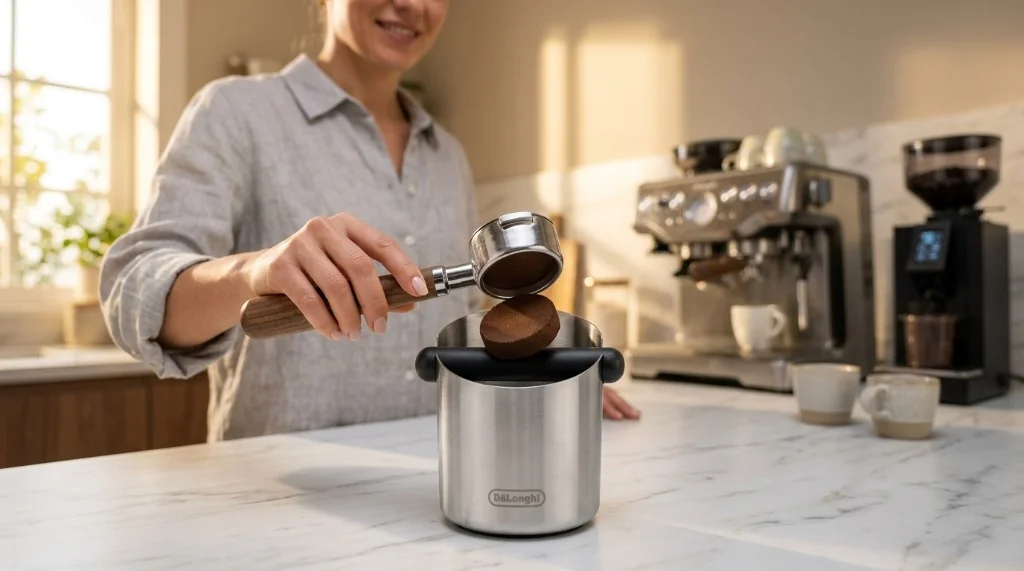
The De'Longhi DLSC084 knock box is the collection's pick: a brushed stainless body with a removable rubberised strike bar, a weighted non-slip base and a roughly ten-puck capacity, listed at approx. €22.40–€22.99 across Germany, France and Italy, with the Breville Knock Box 10 at approx. $33.95 in the US, a JinZeYou bin at approx. £12.99 in the UK and the Ideal Swan box at approx. €17.98 in Spain.
The honest verdict: a knock box is a quality-of-life tool. It will not make your espresso better, and it sits below the scale and tamper in priority. It becomes genuinely valuable at the point where you pull several shots a day and want the workflow contained beside the machine.
Station Organisation — a storage decision, not a gadget decision
Coffee canisters, tiered organisers and shelves make a station calmer, but they belong to a different problem: storage. An organiser only earns its footprint when there is a collection of loose objects — filters, pods, stirrers, tea bags — that would otherwise sprawl across the prep surface. If the setup is a machine, a grinder, a scale and a tamper, an organiser adds an object without solving anything.
Because this is a planning question rather than a product question, it is handled in detail in the companion layout guide: the three storage layers that stop a coffee bar from taking over the kitchen, and the small-kitchen rule to build up rather than out.
Machines: Consolidation Is Not a Gimmick
A machine is not an accessory, and choosing one is a separate purchase decision with its own research. But two categories of machine do belong in a verdict article, because they are sold as solutions to problems that gadgets cannot fix: counter congestion, and beginner uncertainty.
Ninja Luxe Café Premier 3-in-1 — automation where beginners stall
The usual beginner failure is not the machine, it is the grind and tamp loop: shots gush or choke, milk scalds, and the hobby stalls. The Ninja Luxe Café Premier 3-in-1 attacks exactly that sequence with a 25-setting conical burr grinder, Barista Assist dosing with assisted tamping, a four-mode hot and cold frother, and 15-bar espresso plus cold brew and drip in one chassis. It is listed at approx. $499.99 in the US, approx. £499.00 in the UK, approx. €499.90 in Germany and approx. €429.00–€449.99 for the ES601EU across France, Italy and Spain.
The verdict: consolidation, not a shortcut. It removes the two variables beginners struggle with most, and because it uses a traditional portafilter rather than internal brew-group tubing, it does not waste rinse water before and after every shot. It does not remove the need for a scale — the workflow still benefits from one.
Ninja Dual-Brew / Prestige 2-in-1 — the answer to one counter, two habits
Households where one person wants a sixty-second capsule and another wants a full weekend carafe usually end up with two machines and no counter. The Ninja Dual-Brew / Prestige 2-in-1 coffee maker merges them: pod and grounds dual brewing with a 1.8L carafe, ten programmable drink sizes and a fold-away milk frother, listed at approx. $99.98 for the US PB051ST, approx. £259.99 for the UK CFN802UK and approx. €185.00–€237.74 across Germany, France and Italy.
Savepod PodMaker — the single-serve waste problem
Disposable pods cost more per cup than whole beans and generate plastic waste, while bare metal refill pods let sediment sludge through. The Savepod PodMaker reusable pod system uses 100% compostable burst-resistant paper filters in a snap-lock universal ring, listed at approx. $64.99 for the US bundle, approx. £35.27 for the UK Lite kit and approx. €35.00–€35.68 for the 200-filter packs used across France, Italy and Spain.
Skip at First: Gadgets That Solve Problems You Do Not Have
This is the section most accessory content leaves out, and it is the one that saves the most money. None of the following items is useless forever. Each is simply a poor use of money before the basic workflow is stable.
Don't buy every puck-prep gadget
A puck screen is the clearest example. Its most tangible, proven value is cleanliness: the disc keeps grounds from being drawn back into the shower screen and group head, which reduces routine backflushing. It is not a magic extraction upgrade, and it cannot fix an uneven grind, poor distribution or channeling. Buy it for easier cleanup, not for a transformed cup — the cleanliness-versus-extraction breakdown is worth reading before ordering one.
A levelling or distribution tool that duplicates what a WDT tool already does, a bottomless portafilter that makes channeling visible rather than preventing it, a precision basket that matters only after the basics are stable, and a premium tamping station that is organisation and aesthetics rather than extraction all belong in the same bucket. The full skip list from the espresso workflow guide is the short version, and it holds up.
Don't upgrade the tamper just because it looks better
If the tamper that came with the machine fits the basket correctly and produces a level puck, there is no functional reason to replace it. A heavier body and a nicer handle are comfort upgrades. They are entirely legitimate purchases — they are just not decisions that should be presented as necessary, which is why the espresso setup guide makes the same point.
Match the Gadget to How You Actually Brew
There is no universal setup, because the useful list changes with the brew method. The matrix below is the fastest way to see which verdicts apply to you.
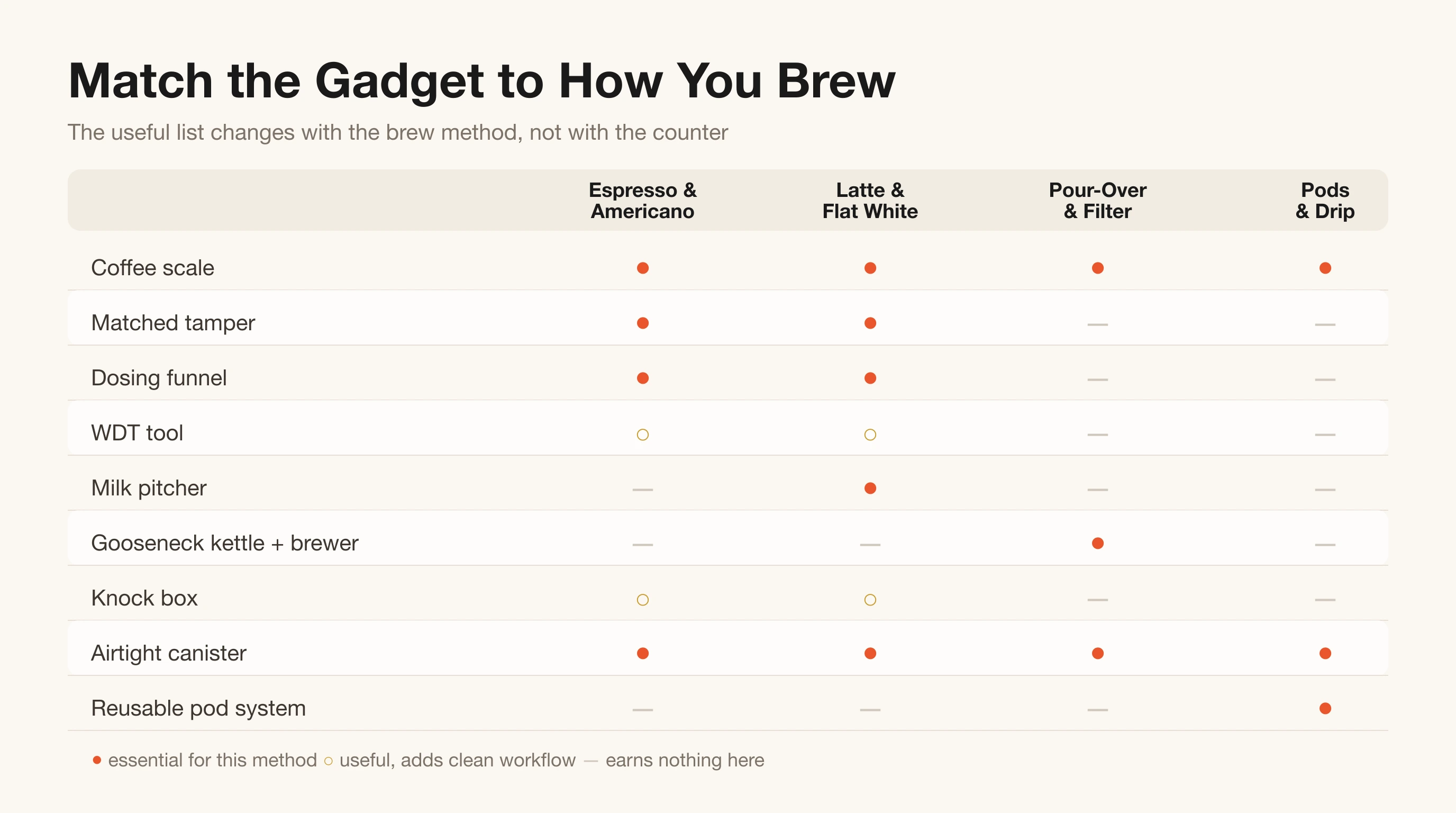
Espresso and Americano drinkers
The complete functional setup is a machine, an espresso-capable grinder, a 0.1g scale and a tamper that fits. A dosing funnel removes the daily mess and a knock box removes the daily trip to the bin, but neither changes what is in the cup, and both can wait a month.
Latte, flat white and cappuccino drinkers
Add a milk pitcher sized for your usual serving, because the steam wand is now part of the core workflow. Keep it to around 350ml for single drinks; step up only if you regularly texture milk for two large mugs at once.
Pour-over and filter drinkers
The espresso accessory list largely does not apply. What matters is a temperature-controlled gooseneck kettle, a scale that also tracks brew water weight and time, a brewer with a reusable or paper filter depending on the body you prefer, and dry, accessible bean storage. A dosing funnel and a knock box are irrelevant here.
Pod and drip drinkers
If the routine relies on a capsule machine or a drip brewer, most of the espresso list is clutter. Prioritise airtight bean storage, a mug shelf and, if pods are the habit, a reusable pod system — the reusable pod breakdown covers the trade-offs.
Buy in This Order
If you take one thing from this article, take the order. Buying in stages is what prevents eight simultaneous variables and the confusion that follows.
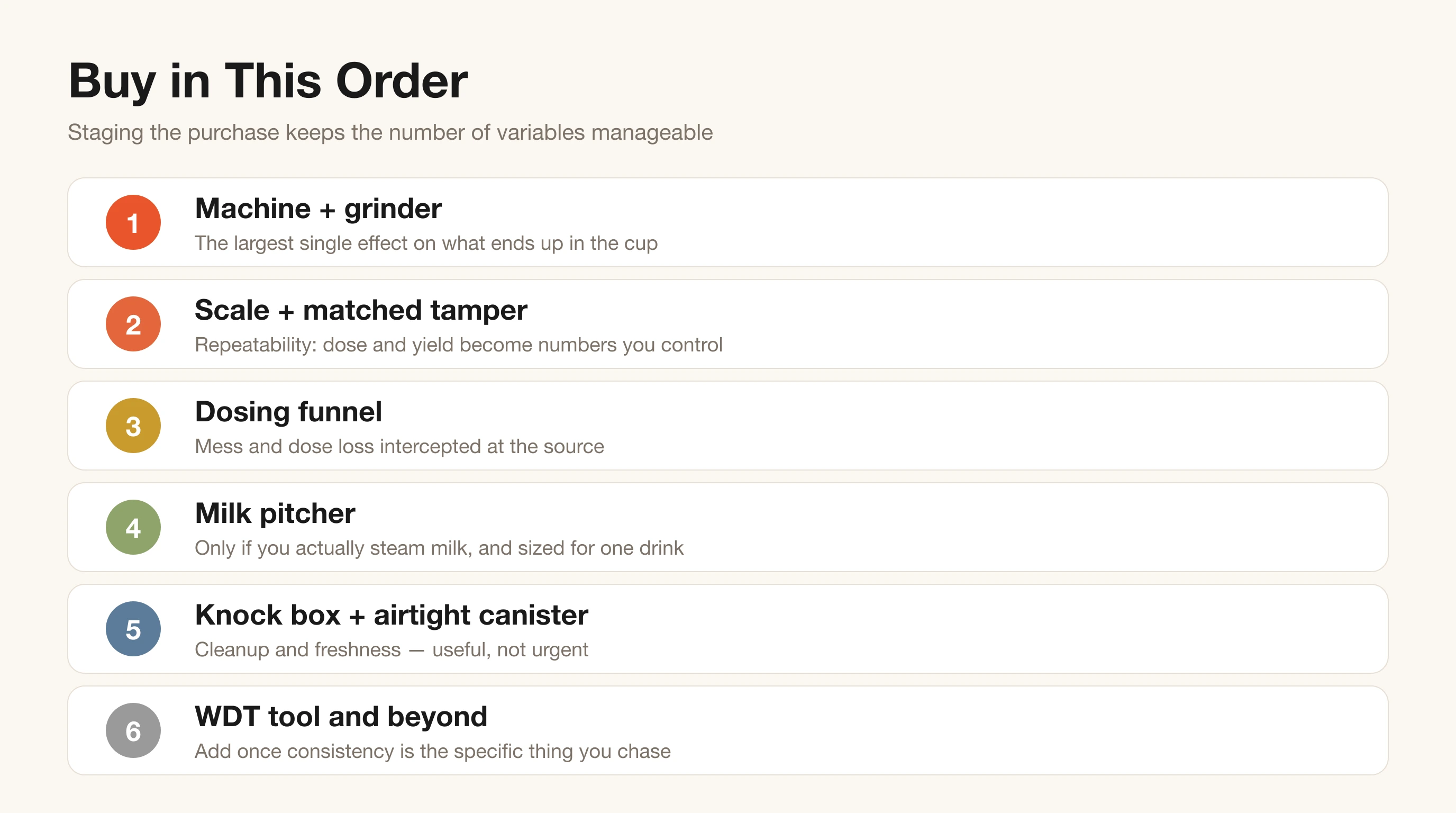
Step 1 — Machine and grinder. Nothing downstream compensates for a grinder that cannot grind fine enough or adjust precisely. This is also the step with the largest effect on the cup.
Step 2 — Scale and a correctly sized tamper. This is the step that turns espresso from a lottery into a process, because it makes dose and yield repeatable and controllable.
Step 3 — Dosing funnel. Once you grind every day, this is the tool you miss most when it is absent. It costs little and pays back in tidiness every morning.
Step 4 — Milk pitcher, only if you steam. Add it when milk drinks are a real part of the routine, not in anticipation of them.
Step 5 — Knock box and canister. Cleanup and freshness. Both are genuinely useful; neither is urgent.
Step 6 — WDT tool, and anything beyond. Add needle distribution when shot-to-shot consistency becomes the specific thing you are chasing. This is also the stage for the upgrades in the skip list, once the basics are stable.
The Verdict, One Line Each
- Coffee scale — actually useful; the single highest-value accessory in the whole list.
- Dosing funnel — actually useful; mess and dose loss intercepted at the source.
- Tamper — actually useful, but only if it fits; a matched tamper beats an expensive one.
- Airtight canister — actually useful; freshness is cheap to protect and expensive to lose.
- WDT tool — useful in the right setup; skip it on a pressurised basket or pre-ground coffee.
- Milk pitcher — useful in the right setup; essential for milk drinks, irrelevant without them.
- Gooseneck kettle and pour-over brewer — useful in the right setup; filter coffee only.
- Espresso cooling balls — useful in the right setup; a real niche for iced espresso.
- Knock box — convenience only; it improves the kitchen, not the shot.
- Station organiser — convenience only; a storage answer to a storage question.
- Puck screen, levelling tool, bottomless portafilter, precision basket — skip at first.
Frequently Asked Questions
Which coffee gadgets are actually worth buying?
The shortest defensible list is a 0.1g coffee scale, a tamper that matches the basket diameter, and a dosing funnel sized to the portafilter. An airtight canister with a one-way valve is the fourth, because freshness is the one variable that degrades on its own. Everything else depends on the brew method and the drinks you make.
Do I need a coffee scale for espresso?
Yes, if repeatability matters at all. A scale tells you both how much coffee went in and how much liquid came out, so when a shot tastes wrong you can identify whether the problem is grind, dose or yield instead of changing several variables at once. It is also the only accessory that makes the others diagnosable.
Is a WDT tool necessary?
Not universally. A WDT tool genuinely helps when you use a non-pressurised basket with freshly ground coffee and you are working on distribution and consistency, because fine needles break up clumps that survive tamping. With a pressurised dual-wall basket or pre-ground coffee, it changes nothing, and for a beginner still mastering dose and grind it is simply one more variable.
Is a dosing funnel worth it?
It is one of the highest-value convenience tools available, and the collection lists magnetic rings and collars from roughly €6 to €20 depending on the market. It stops grounds spilling over the basket rim during grinding and puck preparation, which keeps both the counter and the recipe intact. It does not improve extraction by itself.
Do I need a puck screen?
Not on day one, and not for the reason it is usually sold. The proven benefit is cleanliness: a screen keeps grounds out of the shower screen and group head and reduces backflushing. It is not a substitute for good puck preparation, and it cannot rescue an uneven grind or a channeling bed.
Do I need a knock box?
No, but it is genuinely useful if you pull several shots a day. It contains spent pucks beside the machine instead of sending you across the kitchen with a hot, wet portafilter, and it protects the portafilter ears from a plastic bin rim. It improves cleanup, never extraction.
Do I need a milk pitcher?
Only if you steam milk. For espresso and americano it can be skipped entirely. For lattes, flat whites and cappuccinos it becomes part of the core workflow, and around 350ml is the size that keeps the steam tip at the right depth for a single drink.
Do I need a gooseneck kettle?
Only for pour-over and manual brewing. The narrow spout delivers a controllable stream and digital control holds water at 88–94°C instead of a rolling boil, which is exactly what filter coffee needs. If you brew espresso or full carafes of drip, a standard kettle is faster and the gooseneck earns nothing.
Are espresso cooling balls a gimmick?
No, but the claim needs calibrating. They genuinely drop the espresso stream by 20–30°C within seconds and trap volatile aromatic compounds before they evaporate, which measurably softens harsh bitterness and prevents ice from diluting the drink. They are a real upgrade for iced espresso and a poor one for anyone who drinks hot shots straight.
What should I buy first?
Buy in workflow order: machine and grinder, then a scale and a correctly sized tamper, then a dosing funnel, then a milk pitcher if you steam, then a knock box and canister, and finally a WDT tool if you want to chase puck consistency. This order keeps the number of variables you are managing at any one time as low as possible.
What coffee gadgets can I skip?
Skip puck screens, levelling and distribution tools that duplicate a WDT tool, bottomless portafilters, precision baskets and premium tamping stations until your basic workflow is stable. None of them solves a problem you have on day one, and buying them early adds cost, clutter and variables.
Should I buy more gadgets or a better grinder?
Upgrade the grinder. Grind quality shapes what ends up in the cup more than any accessory, and an espresso-capable grinder is the foundation the rest of the workflow depends on. Accessories solve workflow and cleanliness problems; they do not correct extraction.
Do I need a bottomless portafilter as a beginner?
No. It is a diagnostic and enthusiast tool that makes channeling visible rather than preventing it. It is useful once you are actively diagnosing shots, and it is best treated as a later upgrade rather than a starting requirement.
Where to Go Next
This article is the verdict layer. The three guides below carry the detail behind it.
- Want the full product data? Every tool here is documented with regional models, prices and specifications in our Home Coffee Bar Setup collection — start with the comparison matrix and jump to any section.
- Building the whole counter? The companion layout guide covers how to build a home coffee bar that actually works, including how much counter space a real setup needs and the tools that do not belong on day one.
- Building an espresso setup specifically? The workflow guide walks what an espresso setup actually needs step by step, from dosing and transfer to measuring the shot and knocking out the puck.